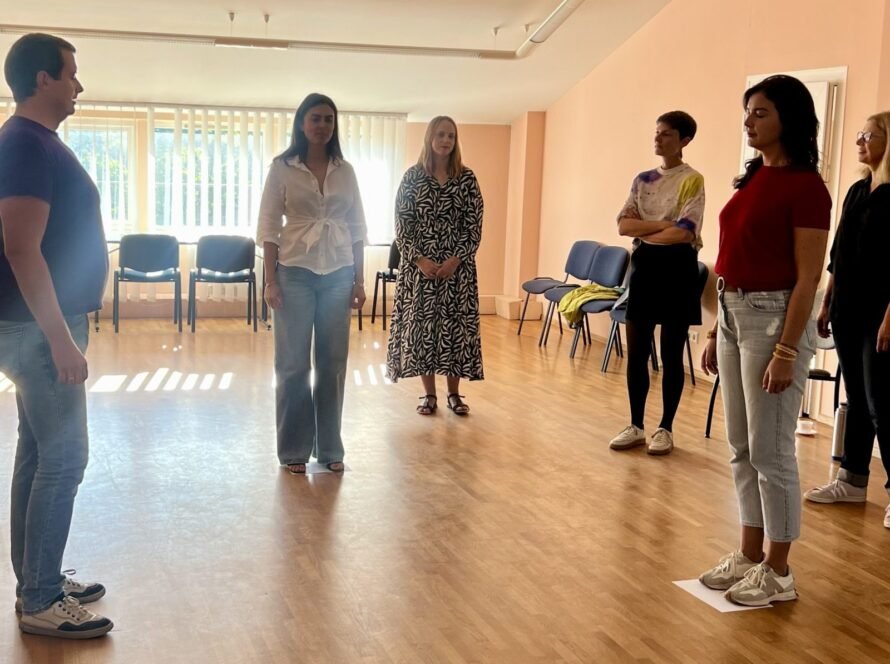
A business constellation is a short, structured session that makes the hidden dynamics of a team or company visible. People or floor markers stand in for parts of the system, such as you, your team, a client, a goal or the market. How they relate in the room shows what is stuck and what would release it. Leaders use it to understand a recurring problem that strategy alone has not solved, usually in 30 to 60 minutes.
Business constellations at a glance
- Also called: organisational constellations, systemic constellations, systemic business coaching
- Origin: adapted from Bert Hellinger’s family constellations for organisations by German practitioners in the 1990s, including Gunthard Weber
- Format: a group workshop with live representatives, or one-to-one (including online) with floor markers or figures
- Length: one constellation usually takes 30 to 60 minutes
- Best for: recurring conflicts, stuck decisions, leadership transitions, succession, mergers and team turnover
- Not: therapy, a personality test or a replacement for strategy
Where business constellations come from
The method grew out of the family constellation work of German psychotherapist Bert Hellinger (1925–2019), who observed that many personal problems are shaped by the system a person belongs to rather than by the individual alone. In the 1990s practitioners in Germany, among them Gunthard Weber, adapted the approach to companies and teams, and set out how the “orders” of a workplace differ from those of a family.
If you want the longer story, read Different Company. Same Problem. Why? and The Invisible Dynamics That Shape Businesses, about the first combined family and business constellations seminar at the Vilnius Chamber of Commerce.
How a business constellation works, step by step
- Name the issue and the outcome you want. For example: “The sales team keeps missing targets after the reorganisation, and I want them working as one team again.” Only a few facts are needed.
- Choose the elements. Typically you, the team, the previous manager, the key client, the target and sometimes something abstract such as “the market”, “the money” or “what’s blocking us”.
- Place them in space. In a group, people stand in for each element. One-to-one, we use floor markers or figures. You place them intuitively, without overthinking.
- Notice what shows up. Representatives describe what they notice from their place: drawn to someone, turned away, heavy, calm. Patterns that were hard to put into words become visible.
- Test small moves. The facilitator moves elements and tests short sentences until the picture settles into something that feels right for everyone in it.
- Take the picture back to work. The new picture is not an instruction. It shows what to acknowledge, include, clarify or let go of, and leaders turn that into concrete next steps.
Five principles that keep showing up in organisations
Practitioners describe a few systemic “orders” that, when ignored, tend to show up as conflict, stagnation or turnover:
- Everyone who contributed has a place. Founders, former leaders and people who left badly still influence the system until their contribution is acknowledged.
- Those who came first have precedence. New leaders who dismiss what was built before often meet quiet resistance.
- Leadership carries priority. Teams settle when the person responsible for the whole is allowed to lead, and becomes unsettled when roles blur.
- Give and take need balance. Chronic over-giving or under-rewarding creates resentment, absenteeism or exits.
- Contribution needs acknowledgement. Exceptional effort that goes unseen tends to turn into withdrawal.
What leaders use business constellations for
- A decision that keeps being postponed, such as a hire, an exit, an investor or a new market
- A team that clashes with every new manager
- Founder or co-founder tension, and succession in family businesses
- Integration after an acquisition or a merger of two cultures
- High turnover or absenteeism in one department
- A personal pattern at work, such as avoiding hard conversations or over-controlling, that keeps repeating in different jobs
In high-pressure industries such as aviation, finance and energy, the issue is rarely a lack of competence. It is usually something in the system that nobody names: a loyalty to a former boss, an unacknowledged founder, or a team still carrying the last restructuring.
What a business constellation is not
- Not therapy. In a business setting the focus is the work system and your role in it, not your personal history.
- Not a replacement for strategy. It shows why a good strategy is not being executed, so the strategy can work.
- Not a prediction. The picture is a working hypothesis to test in reality, not a verdict.
Formal research on constellations is still limited, so it is best used as a diagnostic and reflective tool alongside your usual management practices, by a trained facilitator, and only for issues that genuinely matter.
How we use business constellations at SoulfulB
I’m Audrius Kazlauskas. I spent 18 years leading sales and business development across 70+ countries, including as VP Business Development in aviation, and I trained in Facilitating Business Constellations with Martijn Meima (Intuition in Business). I use the method in two ways:
- The 21-Day Pattern Reset: one-to-one and online, for leaders who keep hitting the same wall under pressure. Six sessions over three weeks, scored on day 1 and day 21. You can keep sensitive details private.
- Systemic Business Dynamics: a live team day using business constellations, followed by one-to-one sessions for each leader and a four-week follow-up.
Frequently asked questions
Do I need a group to do a business constellation?
No. One-to-one constellations work well with floor markers or figures, including online. Groups add live representatives, which some people find more vivid.
Do I have to share confidential details?
No. You can work “blind”: you name the elements without explaining who or what they are, and the details stay with you.
How quickly will I see a difference?
Many people describe more clarity straight after a session. Changes in behaviour and in the team usually show over the following weeks, which is why the 21-Day Pattern Reset includes check-ins and scoring on day 1 and day 21.
Sources
- Gunthard Weber, Organizational Constellations: Basic Principles and Procedures (2000)
- Bert Hellinger, The Hidden Orders in Human Relationship Systems (1999)